
Impossible Artifacts
On the thin line between Inaccuracy and Myth

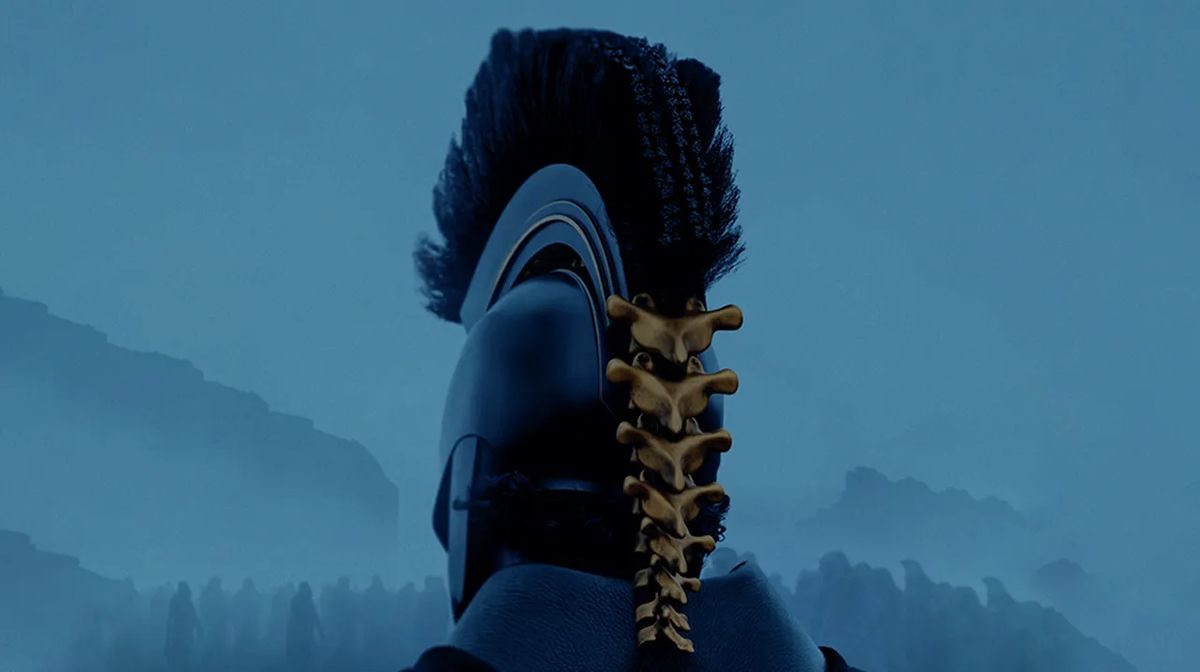
Christopher Nolan’s drop of the Odyssey trailer has unleashed a plague of Bronze Age armor “experts”, all competing to demonstrate that Agamemnon’s all-black, spline-y helmet is, Homerically speaking, impossible. A good many of them are genuinely interested in archaeology. Some have settled on historical inaccuracy as a more socially acceptable proxy of their real complaints: blockbuster cinema is resented for clinging to a nominally “pop” culture (one that everyone, except the filmmakers’ own generation, seems to have outgrown), and for taking patronizing iconic shortcuts to its “good versus bad guys” narratives. Most people, however, join the conversation for the sake of yapping: for the sheer delight of being annoying. And why should I deny myself this pleasure?
Looking for original ways to be annoying, I considered defending Nolan’s choice of armor design. Several routes were available. I could make it “meta”, but that is not really my style. I could diagnose the historical condition of contemporary cinema, but I’m not an old Marxist fogey. Fantasy is more attractive to me, and indeed seems to be where the main line of defense is drawn. The Odyssey is full of fairytale-like elements, after all. A movie should have the freedom to filter the story through a Lord of the Rings or Marvelesque aesthetic. But does invoking a generic notion of “the fantastic” really help us here? On many counts, Nolan’s Odyssey does not (so far) look imaginative enough. The filter is not applied with consistency. The aesthetic discontinuity makes no apology for itself.
Suppose we “read” Agamemnon’s armor as bearing a message of some kind. Movies are not just texts; they’re also, and at the same time, visions. Even if the armor made sense to us, we must ask what Matt Damon/Odysseus could possibly think he is seeing when he’s looking at it. The awe implied in this vision reminded me of something Christopher Nolan recently said in an interview. He wants to produce not fantasy but realistic myth:
One of the things I needed to crack was how to approach mythological elements in a sort of real-world way. The big breakthrough creatively in thinking about the gods was that everything that is now explained by science was once supernatural. Lightning, thunder, earthquakes, volcanoes... people are literally seeing gods everywhere; not even the evidence of gods, they're seeing the actions of gods. I don't want to say too much about it beyond indicating that yes, the evidence of the supernatural is all around these people. It's very much part of their lives. And I think it's quite a lot of fun to tap into that.
I want to take that as seriously as I can. So I asked myself: is there any way that Agamemnon’s armor could be taken as “evidence of the supernatural”? Are there myths about treasures and weapons that look like nothing ever made by (ancient) human hands? The answer is yes. And if you stay with me, I’ll show you how this ties back to Agamemnon.
The heavenly gift and the Daedalic artist
One of the most dramatic episodes to define Odysseus’ character before the Odyssey takes place is the theft of the Palladium, which he and Diomedes have to carry off in order to bring Troy to its knees. The Palladium was a venerably ancient wooden image (xoanon) of the goddess Athena, allegedly fallen from heaven. As long as the besieged city held onto it, it would remain invincible.
The reality of the image was probably visually underwhelming. “Divine” artifacts may have existed for thousands of years previous to the invention of sculpture, and they can be slotted into the art-critical/anthropological category of the manuport: a found object randomly given a rare shape by natural forces, relocated and prized for its “miraculous” aesthetic qualities.
World mythology is rich in treasures of this kind: to this day, the Imperial Regalia of Japan (comprising a sword, a mirror, and a jewel) are said to have been gifted to mortals by the grandson of the sun goddess. The originals are withdrawn from view, which is not untypical. The halo of secrecy surrounding a “self-made” object is what allows for its cultural metamorphosis from a manifestation of Nature’s awesomely creative physis to a sample of uncanny technical skill…
…and forgery bridges the gap between the two.
Ancient Rome believed it enjoyed divine protection in the ancilia, twelve sacred shields whose original had been sent down by the father of the gods during Numa’s reign. The king was worried someone would try to steal the relic, so he asked his lover, the wise nymph Egeria, what should be done to protect it. She counseled him to task the legendary craftsman Mamurius with multiplying the shield, hiding the true one by means of its copies. The mystery and the prestige would henceforth be shared equally among both copies and original, which Numa himself could no longer tell apart (or claimed that he couldn’t.) Mamurius was so skilled he could rival the gods, and his handiwork not only confused but dazzled, fascinated, and ensnared would-be thieves.
The ancient Greeks had a name for craftsmanship that spellbinds, and that name was Daedalus. Daedalic sculpture belongs to the earliest period of Greek art. Its attribution to a mythic figure, itself in proximity to the divine, may express no more than the sheer wonder of graduating from manuports, steles and xoana like the Palladium to finely detailed, fully carved tridimensional simulacra. Daedalic art is imbued with life, but only in so far as statues are so perfectly executed that they seem to breathe, move, and return the gazer’s look. The myth of Daedalus is technological in essence, but in its many iterations, techne and poiesis are not clearly separable.
Mamurius is a Daedalic artist, and like all Daedalic artists he is dogged by misfortune, doomed to be punished for his necessary but scandalous intervention in the divine order of art. A possible interpretation of his feat is that he not only copied the sacred shield but had the audacity to improve it. If so, his crime is not so much that of reprising the divine gesture of creation, but rather that of altering, emending it. If the prehistory of art followed the trajectory I’m describing here, at some point the question of whether it was permissible to modify manuports must have been a heated one.
According to legend, Troy’s Palladium had also ended up in Rome, and was kept in the temple of Vesta. Servius' commentary on the Aeneid reports that Mamurius made numerous copies of the Palladium as well, but was ultimately unable to reproduce a mysterious feature of the original: its mobile eyes and spear. We see here that something had shifted in the story of the Palladium. The rough-hewn wooden xoanon of the archaic period, whose passing resemblance to a human figure was enough to provoke surprise and speculation, had, after a period when Daedalic artistry augmented it, transmogrified into a science-fictional invention, an idealized prototype of technologically-inflected works of art.
In fact, in the late 4th to early 5th century (Servius’ time), state-of-the-art engineering could have produced any number of similarly moving statues. It is telling that the writer’s imagination dares animate parts of the artwork (which he knew could be achieved technically) but goes no further. Athena does not step down from her pedestal and take a walk around the city. (Plato had been far more radical in his appraisal of Daedalic artifacts.)
The history of the cultural notion of “divine artifact” is thus largely the history of exemplary productive activity. Nature is for the longest time the best artificer (Zeus hurls fully formed weapons from the clouds). It is then overshadowed by the divine blacksmith or metalworker (Hephaestus starts receiving commissions from his fellow gods) whose work is only ever accessible through the mediation of human imitators. Finally, the ancient world arrives at the idea of god or gods as the perfect engineer.
If we extend this logic forward to our present, there is no valid reason why we should not picture the products of divine craftsmanship as something that was designed on a computer or printed out using industrial-grade equipment. To see that we have uncontroversially been doing this for decades, it is enough to consider that extraterrestrials have for a time replaced gods and demigods in the collective psyche and in cinema. Whenever we had to represent alien technology, we extrapolated from the most advanced human (industrial) design to date.
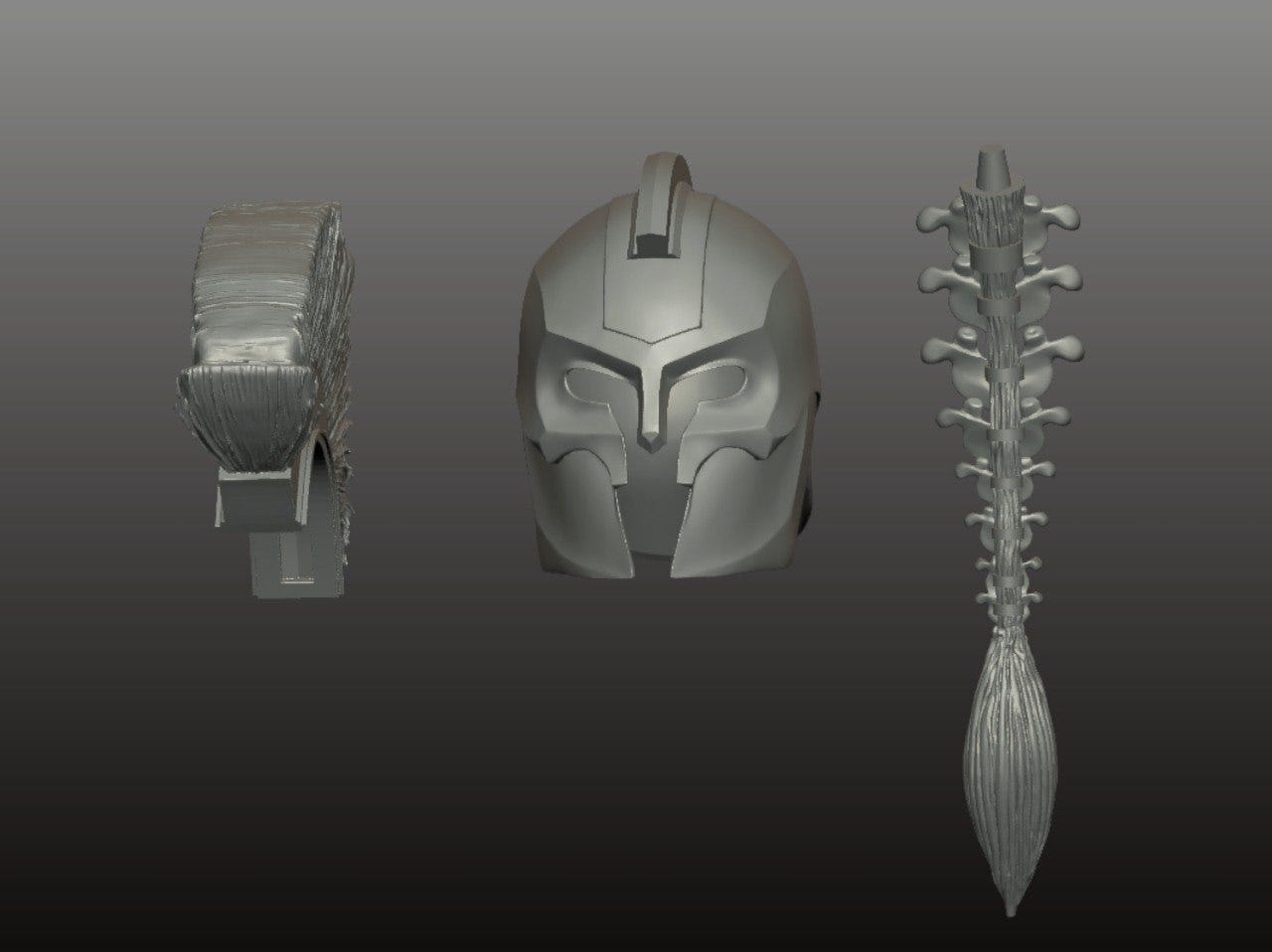
Nolan’s ambition, candidly stated, is to shoot “the IMAX Odyssey”, and to do it in a hi-res mythical way. In my opinion, he’s welcome to insert any number of alien-looking thingies that are too strange for their context and too clichéd for ours. Exotic and familiar at once. This is how it worked in Servius’ time. This is exactly how it’s done.
Let him cook, and remember that, IMAX cameras notwithstanding, cinema has been largely released from the obligation to remediate literature for the masses. Our electronic environment is supposed to do that now. It may not be the best use of your free will, but you can use your free will to listen to the audiobook Odyssey at 2x speed.
Anyway, having established the theoretical legitimacy of alien armor in the Bronze Age (the absurdity of this sentence is intentional, didn’t I promise I was going to be annoying?), the question remains: why on earth should Agamemnon wear one?
Cinyras of Cyprus
Book 11 of Homer’s Iliad contains a description of Agamemnon’s armor, which is said to be intricately wrought and as colorful as the rainbow. The poet’s intention is clearly that of setting before our eyes a miracle of craftsmanship. He informs us that Agamemnon’s breastplate was gifted to him by Cinyras, king of Cyprus.
John Curtis Franklin, Professor of Classics at the University of Vermont, calls Cinyras a “culture-hero” and (like previous generations of scholars) assimilates him to Kinnaru, the “divinized temple-lyre” of Ugarit. Cinyras displays non-trivial Daedalic traits, mostly in the domain of music: he’s an inventor and an artist, a metalworker who improved the craft by introducing the use of various tools, a demigod, and a priest.
So yes, the mythical Agamemnon did have access to divine or semi-divine designer items (just like Achilles) and is allowed to wear whatever he (or Nolan) wants.
I don’t really think Nolan cares about any of this. He was probably just doing a Batman. But no matter how cringe-y his Odyssey may look, it promises to be cinema in a way that this accurate (and utterly philistine) AI-generated trailer is not. Because the Bronze Age slop doesn’t prompt any question. It doesn’t make me want to ramble on about mythology or anything else.
It's "atypical".
It's a movie. As long as they're not in those stupid Spartan Speedos...